
Last Updated on September 23, 2026
How Does a Smile Makeover Actually Work? The Step-by-Step Process in Tampa Bay
A smile makeover follows a precise three-phase process: consultation and smile design, temporary veneer placement, and final ceramic fabrication. The temporaries are placed first so the patient can see and feel the result before anything permanent is made. Every adjustment to size and shape happens during that trial phase, not after.
This is probably the question patients ask most often once they’ve decided they want to do something about their smile. And it’s a fair one. “How does this actually work?” is a completely reasonable thing to want answered before you commit to treatment. The process matters, because how a dentist approaches a smile makeover determines the quality of the result. This article walks through the exact steps followed here, from the first consultation photo to the final ceramic placement.
What to expect at each stage:
- The consultation is where the smile is assessed and the design process begins.
- Temporary veneers are placed before any permanent work is done, giving the patient a preview of the final result.
- The permanent ceramics are only fabricated once the design has been approved and refined through the temporaries.
Ready To Get Started?
Request your appointment at Riverview Dental Art. Discover complete health dentistry!
Call 813.358.4117Request AppointmentWhy Does the Process Matter So Much?
The process determines the outcome. A smile makeover done without a structured design-first approach leaves too many decisions to guesswork. When temporaries are used as a guide, the final ceramics are built from a tested, patient-approved blueprint rather than an untested plan.
A lot of patients assume a smile makeover works like a lot of other procedures: you come in, the dentist does the work, you leave with a result. That’s not how it works here, and honestly, it shouldn’t work that way anywhere.
The reason is straightforward. Teeth are permanent. Ceramic veneers, thin porcelain shells bonded to the front surface of natural teeth to improve their shape, size, and color, are long-term restorations. Ceramic crowns, full-coverage porcelain restorations that cap the entire visible tooth for cases requiring more structural correction, are even more involved. Once those are placed and bonded, the window for easy adjustment is gone.
That’s exactly why the process described here is built around control. The dentist controls the design before the patient’s teeth are touched. The patient approves the result in temporary form before anything is finalized. The lab receives specific, documented instructions based on a tested prototype, not a verbal description. That structure is what separates consistent outcomes from unpredictable ones.
Step One: What Actually Happens at a Smile Makeover Consultation?
During a smile makeover consultation, photos of the patient’s existing teeth are taken and used as the foundation for all subsequent design work. The dentist evaluates tooth shape, size, color, gum line, bite relationship, and facial proportions before any treatment is planned.
The first thing that happens at the consultation is photography. And that might sound like a small detail, but it isn’t. Those photos are the baseline. Everything that gets designed, everything that gets adjusted, everything that gets communicated to the lab, comes back to those first images.
At that appointment, the teeth are assessed in detail. Not just color. Not just shape. The way the teeth relate to each other, how the gum line sits, how the proportions of the front teeth interact with the wider smile, how the bite functions. All of that feeds into the design process. Dr. Espino, with 15-plus years in cosmetic dentistry, evaluates bite alignment, gum balance, and facial harmony at this stage because those elements determine what the final result should look like, not just what the patient wants to change.
Before anything is done to the patient’s mouth, the smile is designed in the lab. The preliminary design is developed from the consultation photos. That design becomes the template for the temporaries.
Step Two: Why Are Temporaries Placed Before the Permanent Veneers?
Temporary veneers are placed before permanent restorations so the patient can see, feel, and live with the proposed result before anything is finalized. They serve as a tested prototype that guides the final ceramic fabrication and eliminates guesswork from the permanent case.
This is the part of the process that surprises most patients. They assume the temporaries are just a filler, something to wear while the permanent ones are being made. They’re not. The temporaries are the design.
Here’s how it works. The preliminary smile design is fabricated in the lab before the patient’s teeth are prepared. Those temporaries are placed in the patient’s mouth, and for the first time, the patient can actually see and feel what their new smile looks like. Not on a screen. Not in a rendering. In their mouth, in their face, in the mirror.
“I want to be able to have control with these cases,” as Dr. Espino puts it. The temporaries are exactly how that control is exercised. If the size needs adjustment, that happens now. If the shape relationship between certain teeth needs to change, that’s noted and refined. If something about the proportions isn’t quite right, it gets corrected before anything permanent is involved.
That’s the whole point of the temporary phase. Not to fill time, but to get the design right. When changes are made to size and shape at this stage, they’re documented clearly so the lab knows exactly what the final ceramics should replicate, and what should be different from the initial prototype.
Step Three: How Are the Permanent Ceramics Made and Placed?
The permanent ceramic veneers or crowns are fabricated using the adjusted temporaries as a direct guide. The dental lab receives specific documented instructions about size, shape, and any refinements made during the trial phase, ensuring the final restorations match the tested, approved design.
Once the temporaries have been worn, evaluated, and refined, the permanent restorations are fabricated. And this is where having an in-house lab changes the process significantly.
The lab doesn’t receive a vague description of what the patient wants. They receive specific, detailed instructions based on an actual prototype that the patient has already approved. Every size change, every shape adjustment, every proportion decision that was made during the temporary phase is communicated directly. The permanent ceramics are built to replicate the best version of what was already tested.
That communication between the treating dentist and the lab is where a lot of practices lose control of their cases. When labs are external and communication is limited to impressions and basic notes, the result is unpredictable. When the dentist has direct access to the fabrication process and can specify adjustments in detail, the final placement is rarely a surprise. It should look exactly like what the patient saw and approved in temporary form.
What Size and Shape Changes Can Be Made During the Process?
Adjustments to tooth width, length, edge shape, and the overall proportion relationships between teeth can all be made during the temporary phase. These changes are documented and carried forward into the permanent ceramic fabrication so that the final result reflects the tested, refined design rather than the original prototype.
This comes up because patients sometimes wonder: how much can actually be changed? The answer is, quite a bit, within clinical limits. Tooth length can be adjusted. Width can be modified. The shape of the incisal edges, the way each tooth transitions into the next, the overall balance across the front of the smile, all of these are refinable during the temporary phase.
The key is that changes are made incrementally and documented carefully. The dentist notes specifically what needs to shift between the temporary and the permanent. That documentation goes to the lab. The lab builds accordingly.
When done this way, the permanent ceramics aren’t the first time the patient sees the result. They’re the final, refined version of something the patient has already lived with and approved. That distinction matters more than most patients initially realize.
Is This Process the Same for Every Smile Makeover Patient?
Yes. The three-phase process of consultation, temporaries, and permanent placement is applied to every smile makeover case regardless of complexity. The specifics change based on the number of teeth, the type of restorations needed, and any underlying health issues, but the structural approach remains consistent.
It’s consistent because consistency is what produces consistent results. Not every case involves the same number of teeth, or the same degree of shape change, or the same combination of veneers and crowns. Cases vary. But the underlying process doesn’t.
Every case starts with consultation photos. Every case goes through preliminary design before teeth are touched. Every patient wears temporaries and has the opportunity to approve and refine the design. Every set of permanent ceramics is fabricated from documented, tested instructions.
“These photos are the progression of our cases and how we go about every single case,” as Dr. Espino puts it. That word, every, is deliberate. Not most cases. Every case. The consistency of the process is what makes the outcome predictable.
How Much Does a Smile Makeover Cost in Tampa Bay?
At Riverview Dental Arts, ceramic veneers and crowns are priced at $500 per tooth with a minimum of six teeth. Pricing scales with the number of teeth included in the aesthetic zone and the scope of the overall treatment plan.
| Treatment Scope | Teeth | Riverview Dental Arts | Tampa Bay Average |
| Minimum case | 6 | $2,995 | $7,200–$12,000 |
| Front eight teeth | 8 | $4,000 | $9,600–$16,000 |
| Upper arch | 10 | $5,000 | $12,000–$20,000 |
| Full aesthetic zone | 16 | $8,000 | Up to $20,000+ |
| Consultation | – | Free | $75–$200+ |
The pricing is below the Tampa Bay market average because every restoration is designed and fabricated in-house. No outside lab fees. No third-party markup built into the estimate. The ceramic quality is identical. The cost structure is not.
Cosmetic veneers are not typically covered by dental insurance. However, if teeth being treated have documented structural damage, portions of the case may qualify for partial coverage depending on the plan. The practice is an in-network PPO provider for most major insurances. Applicable exams and X-rays taken at the consultation can often be billed directly to insurance.
What determines the final cost of a smile makeover?
- Number of teeth treated: At $500 per tooth, total cost scales directly with how many teeth fall within the patient’s visible smile zone. A six-tooth case starts at $2,995. A sixteen-tooth full-arch case is $8,000.
- Type of restoration needed: Ceramic veneers are used for primarily cosmetic corrections. Ceramic crowns are indicated when more structural support is required, such as for teeth with existing damage, large existing restorations, or significant shape changes needed. Crowns typically require more preparation and are priced accordingly.
- Case complexity: Cases requiring bite correction, gum recontouring, or multi-arch treatment involve more clinical planning and more fabrication steps, which affects overall scope and timing.
- Additional restorative procedures: If underlying health issues such as decay, gum disease, or failing old restorations need to be resolved before cosmetic work can begin, those procedures are planned and quoted separately from the cosmetic phase.
- Individual treatment goals: Some patients want to focus only on the upper front teeth. Others want a complete upper and lower transformation. The scope is always determined collaboratively based on what the patient wants and what the clinical evaluation supports.
Is a Smile Makeover Right for You?
If you’ve been thinking about changing your smile and wondering what the process actually looks like from start to finish, the consultation is the most useful thing you can do. It’s not a commitment to treatment. It’s a clear, honest picture of what’s possible and what it would involve for your specific teeth.
The three-phase process described in this article is designed specifically to eliminate uncertainty. You see the result before it’s permanent. You have the opportunity to refine it. Nothing is locked in until you’re satisfied with the design. That’s a very different experience from walking into a procedure and hoping the outcome matches your expectations.
Good candidates are patients with healthy teeth and gums, or with resolvable dental issues that can be addressed before cosmetic work begins, who want to correct concerns like chipping, wear, discoloration, spacing, or overall shape inconsistencies. Patients from across Tampa Bay, including Riverview, Brandon, Valrico, and Apollo Beach, are welcome. Consultations are always free.
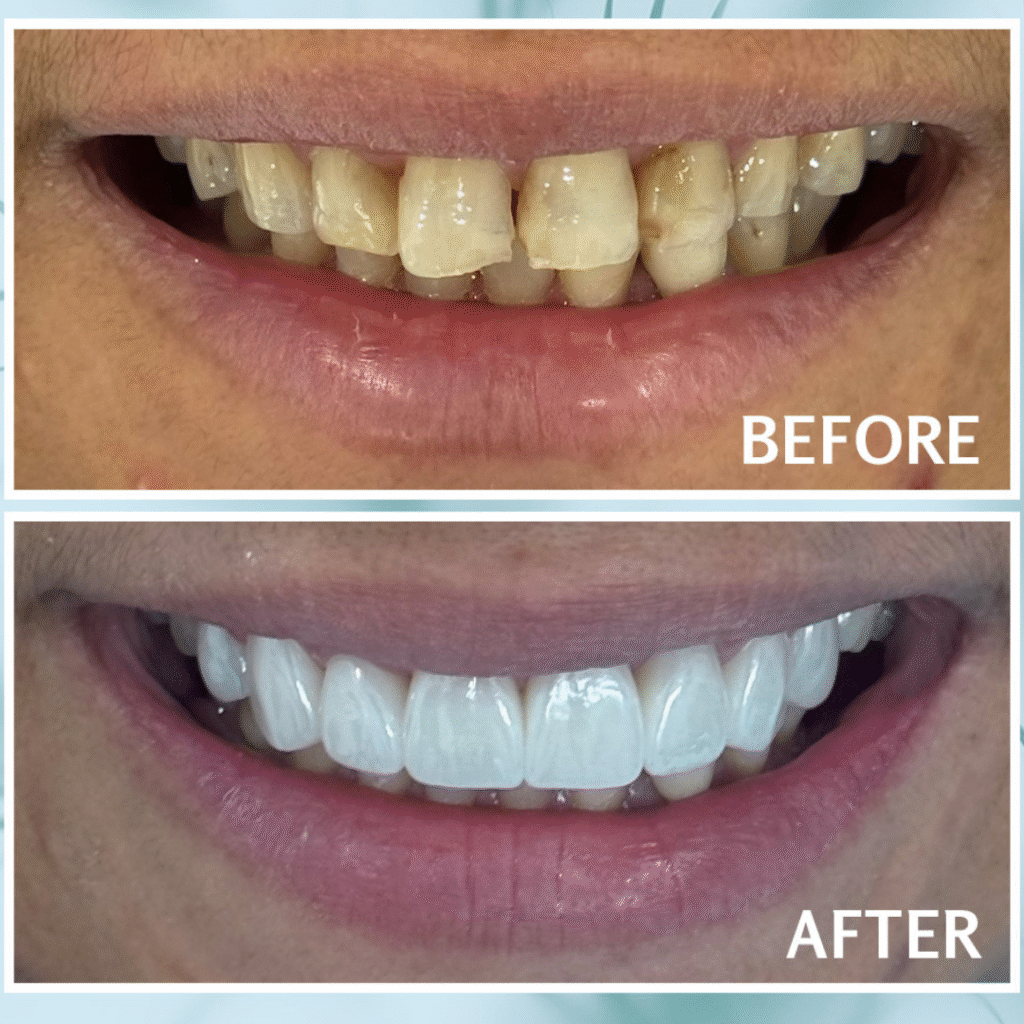
Browse the before and after gallery to see how this process looks across a range of cases, or visit the smile makeover page for more detail on what treatment involves. When you’re ready, schedule your free consultation here.
Frequently Asked Questions
Do I have to wear temporaries, or can the permanent veneers be placed directly?
The temporary phase is a core part of the process, not an optional step. It’s how the design is tested and refined before the permanent ceramics are fabricated. Skipping it means the permanent restorations are made without a tested prototype, which removes the patient’s ability to see and adjust the result before it’s finalized. For a case that’s meant to last ten to twenty years, that testing phase is worth the time.
How long do I wear the temporaries before the permanent veneers are placed?
It varies depending on the case. Most patients wear temporaries for a few weeks. During that time, feedback is gathered, adjustments are noted, and the lab instructions for the permanent ceramics are finalized. Cases requiring more significant design refinements may take a little longer. The goal is always to get the design right before finalizing, not to rush the permanent placement.
Can adjustments still be made after the permanent veneers are placed?
Minor adjustments to bite contacts or minor surface refinements are sometimes made at the final placement appointment. However, the major design decisions, size, shape, proportion, and color, should already be resolved during the temporary phase. That’s the purpose of the three-phase process: to ensure that by the time the permanent ceramics are seated, the patient already knows and approves of the result.
What makes the smile makeover process at Riverview Dental Arts different from other practices?
The in-house lab is the most significant difference. Because the lab is on-site, the treating dentist has direct control over fabrication and can communicate adjustments in precise detail. There’s no relay of instructions through a third party, no delays waiting on an external lab, and no loss of detail in translation. The dentist and the lab are working from the same tested prototype toward the same documented result.
At a Glance
- Who is a good candidate for a smile makeover? Adults with healthy teeth and gums (or resolvable dental issues) who want to correct cosmetic concerns such as chipped, worn, discolored, misshapen, or unevenly spaced teeth. Patients with active gum disease or untreated decay must resolve those issues first; once dental health is confirmed, cosmetic treatment can proceed.
- How long does a smile makeover take from consultation to final placement? Most smile makeover cases are completed within several weeks. The consultation and design phase comes first, followed by temporary placement and a refinement period, then final ceramic fabrication and placement. Cases requiring prior restorative treatment may take longer depending on what needs to be addressed before cosmetic work begins.
- How many veneers are typically needed for a smile makeover? Most smile makeover cases involve six to sixteen ceramic veneers or crowns, depending on how many teeth fall within the patient’s visible smile zone and what their cosmetic goals are. A focused front-teeth case commonly covers six to eight teeth, while a full upper and lower aesthetic zone treatment involves up to sixteen restorations.
- How long do ceramic veneers last? Ceramic veneers and crowns typically last ten to twenty years with proper oral hygiene and regular dental care. Longevity depends on bite alignment, oral habits such as grinding, and whether the underlying teeth were in good health at the time of placement. They are a long-term cosmetic investment, not a temporary cosmetic fix.
- What are the main advantages of veneers over braces for improving a smile? Ceramic veneers correct spacing and alignment while simultaneously addressing chips, discoloration, worn edges, and shape inconsistencies, all in a single treatment phase lasting weeks rather than years. Orthodontic treatment can reposition teeth but cannot change their surface condition, color, or shape. Veneers also involve a tested design process in which the patient sees and approves the result before anything is permanent.