Last Updated on September 23, 2026
Can a Small Tooth Crack Wait, or Should You Fix It Right Away?
A small tooth crack should not wait. Cracks are the leading cause of tooth loss, and they grow over time exactly like a crack in a windshield. Caught early, a crown can protect the tooth completely. Left too long, the crack reaches the root and the tooth cannot be saved. Early treatment is almost always simpler and less expensive than the alternative.
Cracked teeth are one of the most underestimated problems in dentistry, and they’re the most common reason Dr. Espino places an implant. Patients often assume a crack that isn’t causing pain isn’t urgent. That’s not how cracks work. This article explains why cracks are dangerous, how they’re identified, what the treatment involves, and what happens when treatment is delayed too long. The clinical factors involved change case by case, but the core principle doesn’t: waiting makes cracks worse, not better.
Before the full explanation:
- Cracked teeth are the number one cause of tooth loss. Most patients don’t realize this until they’ve already lost a tooth to one.
- Cracks often hide under existing fillings and don’t cause pain until they’ve already progressed significantly.
- A crown placed early holds the tooth together and stops the crack from spreading. Once a crack reaches the root, extraction is the only option.
Ready To Get Started?
Request your appointment at Riverview Dental Art. Discover complete health dentistry!
Call 813.358.4117Request AppointmentWhy Are Cracked Teeth So Dangerous?
Cracked teeth are dangerous because cracks grow over time under the pressure of normal biting and chewing. A crack that is small and treatable today can reach the root of the tooth within months or years, at which point the tooth cannot be saved. Cracked teeth are the leading cause of tooth loss in adult patients.
This is the statistic that surprises most patients: cracks, not decay, not gum disease, are the most common reason Dr. Espino places a dental implant. The teeth that end up lost are overwhelmingly teeth that had cracks that were identified but not treated in time, or that weren’t identified at all until the damage was already done.
The reason cracks are so destructive is simple. Every time you bite down, the two sides of a crack flex apart slightly. Over hundreds of thousands of biting cycles, that small movement drives the crack deeper. It’s the same mechanical principle as metal fatigue. The crack doesn’t need a single dramatic event to get worse. It gets worse through normal, everyday use.
And the pain doesn’t always come when you’d expect it. A lot of cracked teeth don’t cause significant discomfort until the crack has already reached a point where the prognosis changes. That’s what makes them dangerous. By the time a patient feels something is seriously wrong, the window for conservative treatment may already be closed.
How Do Dentists Find Cracks That Aren’t Visible to the Patient?
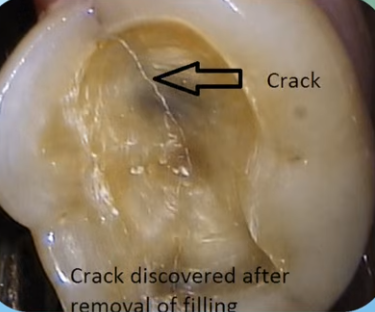
Many tooth cracks hide beneath existing fillings and are only visible once the filling is removed. Under direct examination, a crack appears as a dark line running through the tooth structure. Digital imaging and clinical probing are used to assess how far the crack has progressed before deciding on a treatment approach.
One of the more striking things about crack detection is where cracks tend to hide. Old fillings, particularly larger fillings that have been in place for years, frequently conceal cracks underneath them. The filling holds the tooth together well enough that the patient doesn’t notice anything wrong. But when the filling comes out, whether because it needs replacing or during a clinical examination, the crack is clearly visible as a dark line running through the tooth.
In cases with existing fillings, Dr. Espino has seen that crack clearly: a dark line that runs through the tooth structure underneath where the filling sat. That visual finding immediately changes the treatment plan. The question at that point isn’t whether the tooth has a crack. It’s how far the crack has gone and whether it’s still in treatable territory.
This is one reason regular dental examinations matter beyond just cleaning. Catching a crack under an aging filling before it reaches the root is a very different clinical situation from discovering one that has already progressed too far to save the tooth.
What Is the Treatment for a Cracked Tooth?
The standard treatment for a cracked tooth that has not yet reached the root is a dental crown. A dental crown, also called a ceramic crown, is a full-coverage porcelain restoration that caps the entire visible portion of the tooth, holding the two sides of the crack together and preventing it from propagating further under biting forces.
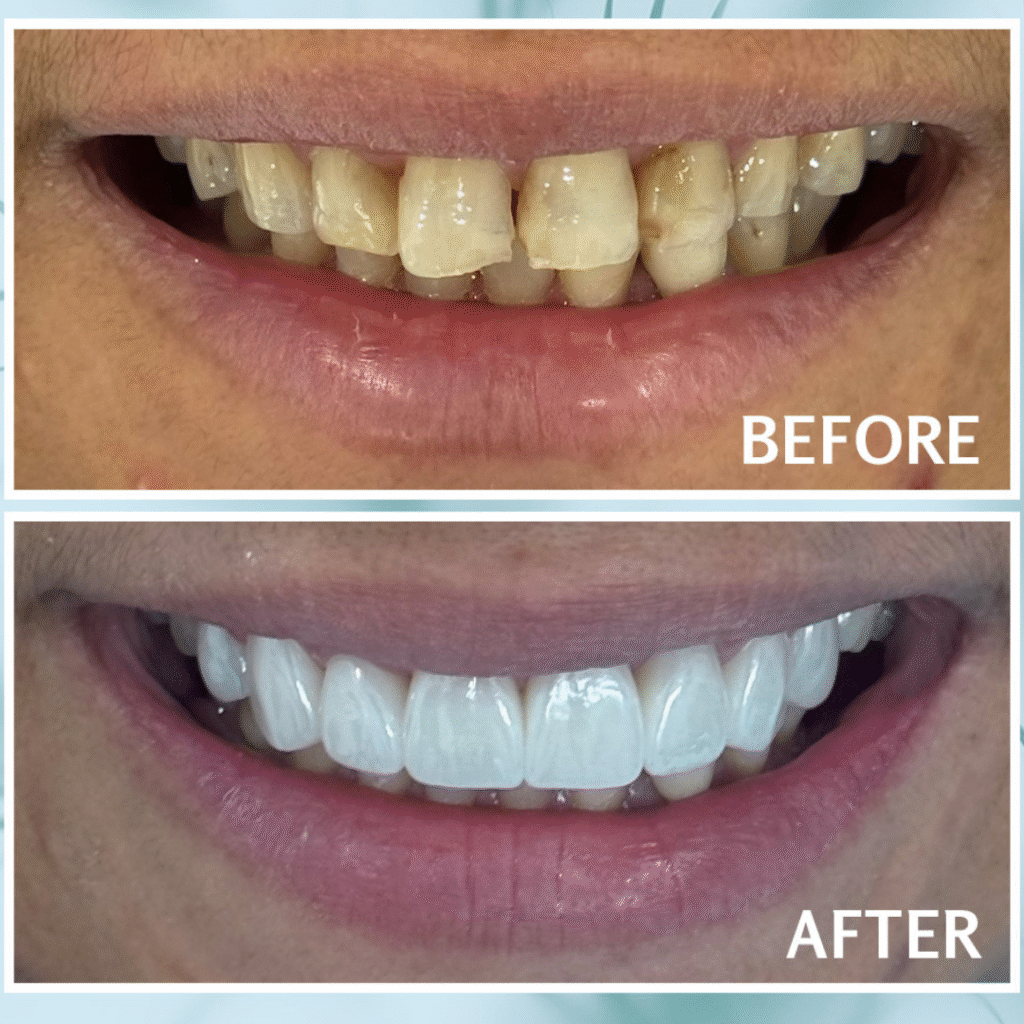
Ceramic crowns are full-coverage porcelain restorations that completely enclose the tooth above the gumline, designed to protect compromised tooth structure from further damage. Ceramic veneers, by contrast, are thin porcelain shells bonded to the front surface of natural teeth to improve their shape, size, or color, and are used for cosmetic correction rather than structural stabilization of a crack.
For a cracked tooth, a crown is the appropriate treatment because of what it does mechanically. It holds the tooth together. Every time you bite down, instead of the crack being forced apart by the pressure, the crown distributes that force evenly around the outside of the tooth. The crack can’t spread because it’s enclosed. That’s what makes a crown the right tool for this specific problem.
The windshield analogy Dr. Espino uses is one of the clearest ways to explain it. Everyone has seen a small chip or crack in a windshield. You have a choice: fix it now while it’s small and contained, or wait. If you wait and drive on the highway, the vibration and pressure cause the crack to run. What was a small chip becomes a line across the entire windshield. At that point, the repair is no longer a small fix. It’s a full replacement. The tooth works the same way. Treat the crack early with a crown and the tooth is saved. Let it run to the root and there’s nothing to repair. The tooth has to come out.
What Happens If a Crack Reaches the Root?
When a crack reaches the root surface of a tooth and extends through the full thickness of the root, the tooth cannot be saved. The only treatment at that stage is extraction. After extraction, a dental implant is typically the best option to replace the lost tooth, which is a significantly more involved and expensive process than a crown placed when the crack was still treatable.
This is the outcome that makes early crack treatment so important. A crack that runs down the root surface and through to the other side creates a structural failure that no restorative technique can fix. The tooth has to come out.
And then there’s the next problem. Once a tooth is extracted, the space has to be dealt with. Adjacent teeth shift toward the gap over time. The opposing tooth over-erupts. The bite changes. A dental implant, which replaces the root and crown of the lost tooth independently, is generally the best long-term replacement option, but it involves surgical placement, a healing period, and a total investment substantially higher than a crown placed when the crack was still manageable.
Dr. Espino is direct about this in clinical conversations. If a crack goes down the root surface and through and through, he can’t save it. That’s not a failure of technique. That’s the mechanical reality of a complete structural fracture in a tooth. The only way to avoid that outcome is to treat the crack before it gets there.
Does a Cracked Tooth Always Hurt?
No. Many cracked teeth cause little or no pain, especially in the early stages. Pain from a cracked tooth often appears only when the crack has already progressed significantly, which is why the absence of pain is not a reliable indicator that a crack is safe to monitor without treatment.
This is probably the biggest misconception patients carry about cracked teeth. If it doesn’t hurt, it must be fine. That’s not how cracks behave.
Early cracks, even ones hiding under old fillings, often cause no symptoms at all. The tooth feels normal. Biting on it feels normal. Nothing flags it as a problem. That’s exactly why clinical examination matters: the dentist can see or detect a crack that the patient has no reason to suspect is there.
By the time a cracked tooth starts causing consistent pain, especially sensitivity to temperature or pain that lingers after biting, the crack has typically progressed into the pulp tissue of the tooth. At that stage, the treatment changes. Root canal therapy may be needed before the crown is placed. And if the crack has gone deeper still, the prognosis for saving the tooth drops further.
No pain does not mean no problem. It means the problem hasn’t announced itself yet.
What Does It Cost to Treat a Cracked Tooth, and What Does Insurance Cover?
At Riverview Dental Arts, ceramic crowns used to treat cracked teeth are $500 per tooth as part of a smile makeover plan. For single-tooth restorative crown placement on a cracked tooth, most PPO dental insurance plans provide partial coverage, typically 50% of the insurance-based rate after the deductible is met. An in-network provider like our practice ensures the insurance-based rate applies, keeping out-of-pocket costs predictable.
|
Scenario |
Treatment |
Typical Insurance Coverage |
Notes |
|
Crack caught early |
Crown |
50% PPO after deductible (in-network) |
Tooth fully preserved |
|
Crack reaches pulp |
Root canal + crown |
Root canal often covered separately |
More complex, longer treatment |
|
Crack through root |
Extraction + implant |
Extraction often covered, implant varies |
Tooth cannot be saved |
The cost difference between these three scenarios is significant. A crown placed on a manageable crack is the least expensive path. A root canal followed by a crown is more involved. An extraction followed by implant placement is the most expensive outcome and the one that could have been prevented. Insurance coverage typically applies to medically necessary crowns placed on cracked teeth, unlike purely cosmetic veneers, which are generally not covered by PPO plans.
The practice is in-network with most PPO insurance plans. The team verifies benefits and files claims on behalf of patients, so there are no surprises on the cost side before treatment begins.
What determines the cost of treating a cracked tooth?
- Stage of the crack at diagnosis: Early cracks require a crown only. Cracks that reach the pulp require root canal therapy in addition to the crown. Cracks that extend through the root require extraction and implant placement, the most expensive outcome.
- In-network versus out-of-network status: A crown at an in-network PPO provider is billed at the insurance-based rate, with the patient covering their plan’s percentage. An out-of-network office charges its own fee and bills the patient the difference after insurance pays its share of the lower rate.
- Number of teeth affected: Cracks can be present in multiple teeth simultaneously. Each requires evaluation and, if treated early, its own crown placement.
- Whether prior restorative work is needed: Existing fillings may need to be removed to fully assess the crack before a crown is placed, which is typically included in the treatment plan.
When Should You Have a Suspected Crack Evaluated?
The honest answer is: as soon as you’re aware one might exist. And if you haven’t had a comprehensive examination recently, that’s a reason to schedule one regardless of whether you have symptoms.
Cracks that are caught early are almost always manageable with a crown. The treatment is predictable, the prognosis is good, and the tooth is preserved. The further a crack progresses before it’s treated, the worse those odds get and the more complex and expensive the path forward becomes.
If you have older fillings, a grinding habit, or teeth that have been chipped or cracked before, a clinical evaluation is the right starting point. Dr. Espino has 15-plus years of experience identifying and treating cracked teeth across all stages of progression, and consultations at our office are free. Patients from Riverview, Brandon, Valrico, and Apollo Beach are welcome.
When you’re ready to find out where you stand, schedule your free consultation here.
If you’re also curious about cosmetic treatment, free consultations are available. You can also browse the smile makeover page for an overview of cosmetic services. Browse the before and after gallery to see how vertical dimension cases look before and after treatment.
Frequently Asked Questions
Can a cracked tooth heal on its own?
No. Unlike bone, tooth structure does not regenerate or heal. A crack in a tooth will not close or stabilize on its own. Under the forces of normal chewing, cracks grow over time. The only way to stop a crack from progressing is clinical treatment, typically a dental crown that holds the tooth together and prevents the crack from spreading further under biting pressure.
How do I know if I have a cracked tooth?
Many cracked teeth cause no obvious symptoms, especially early on. When symptoms do appear, they often include sharp pain when biting, sensitivity to cold or sweet foods, or discomfort that comes and goes without a clear cause. Because cracks frequently hide under existing fillings and don’t cause reliable pain until they’ve advanced, the most reliable way to identify a cracked tooth is a clinical dental examination, not waiting for symptoms to appear.
What happens if a cracked tooth is left untreated?
An untreated crack will continue to grow deeper into the tooth. Depending on how quickly it progresses, an untreated crack can reach the pulp tissue of the tooth, requiring root canal therapy before a crown can be placed, or eventually extend through the root, at which point the tooth cannot be saved and must be extracted. The further the crack progresses before treatment, the more complex, costly, and difficult the treatment becomes.
Is a crown the only treatment for a cracked tooth?
For most cracked teeth that are still salvageable, yes. A crown is the standard treatment because it physically encircles the tooth and prevents the crack from being forced apart under biting pressure. In cases where the crack has reached the pulp, a root canal may be needed before the crown is placed. In cases where the crack has extended through the root, extraction is the only remaining option. Early treatment, before the crack reaches either of those stages, gives the best outcome with the least intervention.
At a Glance
- Who is at risk for a cracked tooth? Any adult with older large fillings, a grinding habit, a history of chipped or cracked teeth, or prior dental trauma is at elevated risk for a tooth crack. Cracks are the leading cause of tooth loss in adult patients and are most common in back teeth that absorb the highest biting forces. Regular clinical examinations are the most reliable way to identify cracks before they progress to an untreatable stage.
- How quickly should a cracked tooth be treated? As soon as it is identified. Cracks do not stabilize on their own and grow deeper with every biting cycle. A crack that is treatable with a crown today may reach the pulp or the root within months of continued use without treatment. There is no safe monitoring period for a confirmed crack. Early treatment preserves the tooth, delayed treatment increases the risk of losing it.
- How many teeth typically need to be treated for cracks? It depends entirely on the individual case. Some patients have a single identifiable crack. Others, particularly those with grinding habits or multiple older large fillings, may have cracks in several teeth simultaneously. Each tooth is evaluated individually. Treating multiple cracked teeth at the same time is possible and may allow for more efficient use of insurance benefits within a single calendar year.
- How long does a crown placed on a cracked tooth last? A ceramic crown placed on a cracked tooth that is otherwise healthy typically lasts ten to fifteen years or longer with proper oral hygiene and regular dental care. The crown itself does not fix the underlying crack, it stabilizes it. As long as the crown remains intact and properly seated, it prevents the crack from progressing. Patients with grinding habits should wear a nightguard to protect both the crown and the remaining tooth structure from ongoing biting forces.
- What are the advantages of treating a crack with a crown versus waiting? Treating a crack early with a crown preserves the natural tooth, avoids the need for root canal therapy, eliminates the risk of extraction, and costs significantly less than implant placement to replace a tooth that could not be saved. A crown placed at the right time is one of the most cost-effective decisions in dentistry. Waiting does not make the crack smaller or the treatment easier. It narrows the options and increases the eventual cost.