
Last Updated on September 23, 2026
Why Are My Front Teeth Turning Translucent? Acid Erosion and How to Fix It in Tampa Bay
Translucent, thin, or visibly worn front teeth are most commonly caused by acid erosion – a process that chemically dissolves natural enamel over time. At Riverview Dental Arts in Riverview, FL, Dr. Derek Espino restores eroded teeth using custom ceramic veneers and crowns, including a temporary phase that lets patients preview and refine the result before permanent restorations are placed.
Ready To Get Started?
Request your appointment at Riverview Dental Art. Discover complete health dentistry!
Call 813.358.4117Request AppointmentWhy Do Front Teeth Start to Look Worn, Thin, or See-Through?
Front teeth turn translucent because acid erosion has chemically dissolved the enamel layer – the hard outer surface that gives teeth their natural color, structure, and light-reflecting quality. Once enamel is gone, it does not regenerate on its own.
A lot of patients notice this gradually. The edges of the front teeth start looking glassy. The teeth seem shorter than they used to be. There’s a faint see-through quality at the tips that wasn’t there before. And the instinct is usually to try whitening – which doesn’t help, because this isn’t a color problem. It’s a structural one.
What you’re seeing is enamel loss. And enamel, once dissolved, doesn’t come back without restorative treatment. That distinction matters – because it completely changes the treatment approach.
This is one of the most common cosmetic concerns seen at Riverview Dental Arts across patients from Tampa Bay, Riverview, Brandon, and Valrico. And it’s one of those situations where early evaluation makes a real difference in how straightforward the fix can be.
What Causes Acid Erosion on Front Teeth?
Acid erosion is caused by repeated exposure to acidic substances – most commonly sodas, citrus, sports drinks, coffee, acid reflux, or frequent vomiting. The acid chemically dissolves enamel over months and years, producing visible thinning, translucency, and structural vulnerability.
The cause is usually dietary – but not always in the ways patients expect. Here’s what drives it most often:
- Carbonated drinks – sparkling water, sodas, and energy drinks all carry low pH levels that attack enamel with regular consumption, even in small amounts
- Citrus and acidic foods – frequent lemon, vinegar-based sauces, or fruit juice exposure compounds quickly over time
- Acid reflux (GERD) – stomach acid reaching the mouth repeatedly, often during sleep, causes significant enamel breakdown that patients often don’t connect to their dental changes
- Sports and energy drinks – among the most erosive beverages available, and commonly consumed by patients who assume they’re making a healthy choice
- Frequent vomiting – chronic nausea or eating disorders expose teeth to highly concentrated stomach acid on a regular basis
The critical point here is that erosion is chemical, not mechanical. Brushing harder didn’t cause it. Brushing softer won’t fix it. The enamel is gone. The only path to restoration is rebuilding with ceramic – and that’s exactly what veneers and crowns do.
What Does Acid Erosion Actually Look Like in a Real Patient Case?
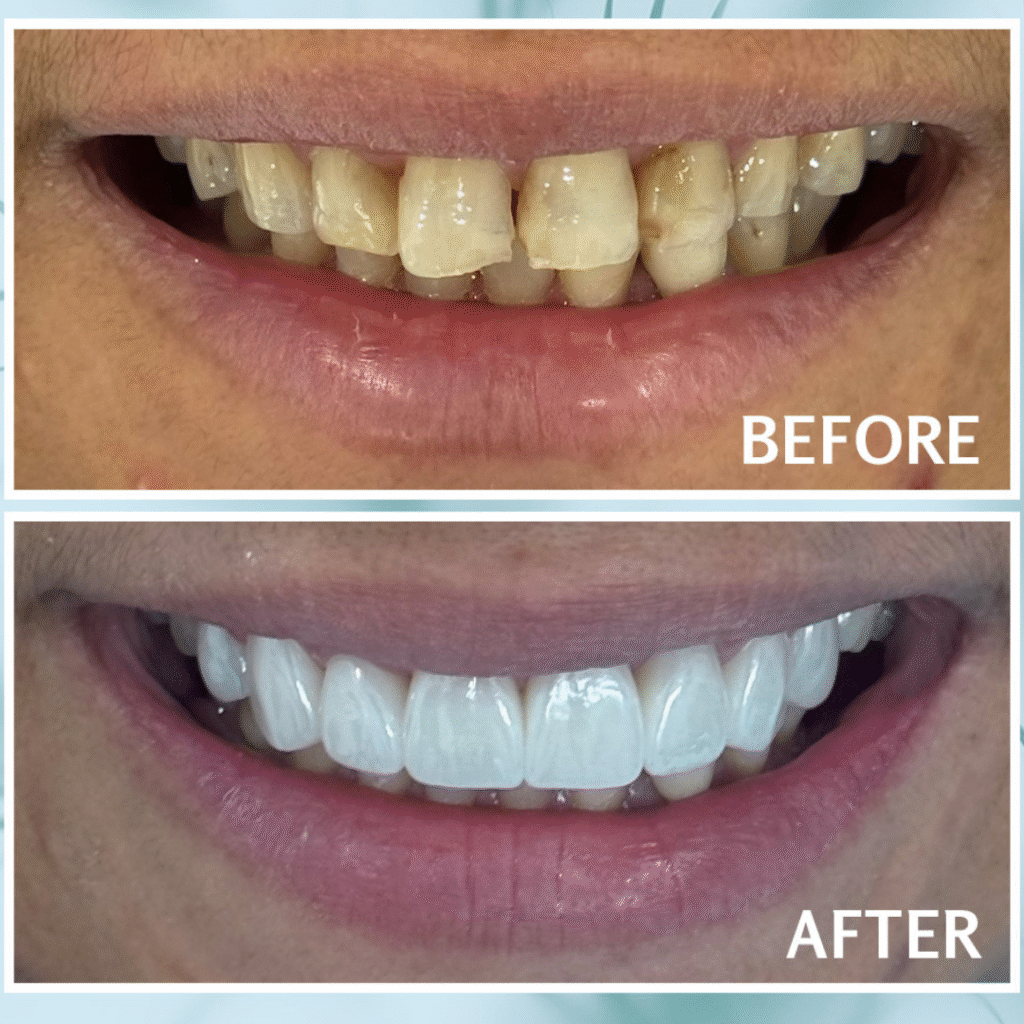
In a significant erosion case, the front teeth appear shorter, flatter, and glassy at the edges. The natural surface texture is compromised, the dimensional quality of the smile is reduced, and the translucency that appears at the tooth edges indicates the enamel layer has thinned to the point where the underlying tooth structure is visible through the surface.
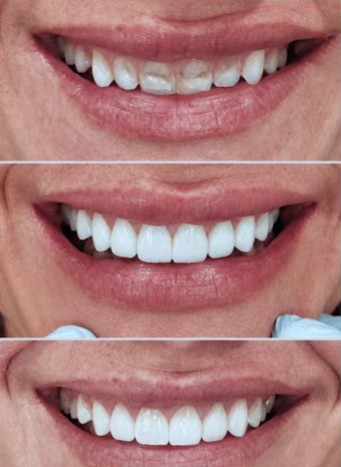
The case in this video shows the progression clearly. The first photo – taken at the consultation – shows significant acid erosion on the first few front teeth. The surface has lost its texture. The edges are worn flat. The teeth look dimensionally collapsed compared to what a healthy, full smile should look like.
That’s not something whitening addresses. The enamel isn’t stained – it’s gone. What remains is a structurally compromised surface that will continue breaking down under normal acid exposure unless it’s rebuilt with a permanent restoration.
That’s the clinical baseline. From there, the question is how to fix it properly – not just cosmetically, but in a way that holds up long-term and produces a result the patient actually loves.
How Does the Smile Makeover Process Work – From Erosion to Final Result?
A smile makeover for acid erosion follows three documented phases: a consultation assessment, a temporary restoration phase where the size, shape, and shade are evaluated and refined directly in the patient’s mouth, and a final delivery of permanent ceramic restorations based on the approved temporary design.
This three-phase process is what separates a well-planned cosmetic case from one that produces a result the patient has to live with rather than love. Here’s how each phase works:
Phase 1: Consultation Assessment
The first photo in this case is from the consultation. The erosion is documented. The bite is evaluated. The treatment scope is determined. Dr. Espino assesses not just what’s damaged, but how the restorations need to be designed to work with the patient’s bite, gum levels, and facial proportions. Every case is custom-planned – there’s no template here.
Phase 2: Temporaries Made Directly in the Mouth
After preparations are complete, temporaries are made in the patient’s mouth. The middle photo in this case shows that stage – and it’s arguably the most important step in the entire process.
“The value of having a well-made temporary is for us to look at it together.” That’s the key phrase. At this stage, the patient can actually see the size, the shape, and the color – in their own mouth, in real lighting – before any permanent ceramic is fabricated. Adjustments are still possible. If the shade feels too bright, it can be dialed back. If the proportions feel slightly off, they can be refined. This is where the patient becomes a genuine collaborator in the final outcome.
Phase 3: Permanent Ceramic Delivery
The third photo shows the final permanent restorations. In this case, the patient decided to go with a slightly more natural shade than the temporaries – a refinement that was made possible by the temporary review phase. The final ceramic was adjusted accordingly, and the result is a complete, natural-looking restoration that addresses both the structural damage from erosion and the cosmetic appearance of the smile from every angle.
That’s what a properly managed smile makeover looks like from start to finish. Thorough, collaborative, and dialed in before anything is permanent.
Why Are Temporaries So Important – Can’t You Just Go Straight to Final?
Temporaries are essential because they allow both the patient and the dentist to evaluate the real-world appearance of the planned restorations before permanent ceramic is fabricated. No digital preview or planning software replicates the experience of seeing and feeling the actual shape and shade in your own mouth.
A lot of patients assume temporaries are just a placeholder. That’s part of it – but a well-made temporary does something no design software or mock-up photo can replicate. It shows you exactly what the final result will look and feel like in your own mouth, with your own lip movement, in your own light.
That’s a different kind of preview. And it’s when the most meaningful fine-tuning happens.
In this case, the patient reviewed the temporaries and decided on a slightly more natural shade for the permanent restorations. A small but significant detail – easy to adjust at the temporary stage, and impossible to undo after the permanent ceramic is placed.
Skipping this phase to save time or cost is one of the most common reasons patients end up dissatisfied with cosmetic work done elsewhere. It’s not a shortcut – it’s a core step in producing a result that holds up both aesthetically and clinically.
Veneers or Crowns – Which Is Right for Acid Erosion Cases?
Acid erosion cases may be treated with porcelain veneers, ceramic crowns, or a combination of both, depending on the degree of structural damage to each individual tooth. Veneers are appropriate when the remaining tooth structure is stable; crowns are better suited when erosion has significantly compromised the tooth’s foundation.
The distinction matters, and it’s determined tooth by tooth – not by a blanket preference for one option over another.
| Factor | Porcelain Veneers | Ceramic Crowns |
| Coverage | Front surface only | Full tooth cap |
| Best for erosion severity | Mild to moderate | Significant structural loss |
| Tooth reduction required | Minimal | More significant |
| Addresses shade? | Yes | Yes |
| Addresses shape and length? | Yes | Yes |
| Cosmetic outcome quality | Natural, full result | Natural, full result |
In many erosion cases, we use both across the arch – crowns where structural need is higher, veneers where it isn’t. That decision is made during the initial evaluation based on what each tooth actually needs. More detail on each option is available on the veneers page and ceramic crowns page.
What Does Treatment for Acid Erosion Cost in Tampa Bay?
Answer: At Riverview Dental Arts in Riverview, FL, ceramic veneers and crowns for erosion cases are $500 per tooth with a minimum of six teeth – well below the Tampa Bay market average of $1,200 or more per tooth at most cosmetic practices.
Here are the numbers directly:
| Treatment Scope | Teeth | Riverview Dental Arts | Tampa Bay Average |
| Minimum case | 6 | $2,995 | $7,200–$12,000 |
| Upper arch | 8 | $4,000 | $9,600–$16,000 |
| Upper + lower partial | 12 | $6,000 | $14,400–$24,000 |
| Full aesthetic zone | 16 | $8,000 | Up to $20,000+ |
| Consultation | – | Free | $75–$200+ |
The price difference comes from the in-house lab. Dr. Derek Espino designs and fabricates every veneer and crown at Riverview Dental Arts – eliminating the third-party lab markup that drives up cost at most practices – without any compromise in ceramic quality, precision, or natural appearance.
Purely cosmetic treatment typically isn’t covered by insurance. However, teeth with significant structural erosion may qualify for partial coverage depending on your plan. Riverview Dental Arts is an in-network PPO provider for most major insurances. Exams and X-rays at the consultation can be billed to your insurance when applicable.
When Should You Come In – And What Happens If You Wait?
Acid erosion should be evaluated as soon as teeth begin to look visibly worn, shorter, or translucent at the edges. Delaying treatment allows the erosion to continue – removing more enamel, increasing structural vulnerability, and expanding the scope of what’s needed to fix it.
Enamel doesn’t grow back. Every additional month of acid exposure removes more of what’s left. A straightforward six-tooth case today can become a more complex, more costly case in a year or two – not because anything dramatic happened, but because the damage continued while treatment was deferred.
A few signs it’s time to come in:
- The edges of your front teeth look glassy, translucent, or see-through
- Your front teeth appear shorter or flatter than you remember
- You’re noticing increased sensitivity along the tooth edges
- Chipping is becoming more frequent
- You’ve whitened repeatedly without the result improving – because the issue is structural, not a surface stain
That last point is worth repeating. Whitening treats color. It has zero effect on worn enamel or missing tooth structure. Patients who’ve been whitening for years without satisfaction often have an underlying erosion issue – and until that’s addressed structurally, no whitening product will produce a complete result.
If any of this sounds familiar, the right step is a free consultation at Riverview Dental Arts. Dr. Espino will assess the degree of erosion, walk through what realistic treatment looks like for your specific case, and give you a clear picture of your options – no pressure, no commitment. Patients from across Tampa Bay, including Riverview, Brandon, Valrico, and Apollo Beach, are welcome.
Book your free smile consultation here. Or learn more about the full process on the smile makeover page and browse real patient results in the before and after gallery.
Frequently Asked Questions
Why do my front teeth look translucent or see-through at the edges?
Translucent front teeth are a sign of acid erosion – a process where acidic foods, drinks, or stomach acid dissolves the enamel layer over time. As enamel thins, the tooth becomes more transparent, particularly at the edges. This is a structural issue that whitening cannot reverse. Ceramic veneers or crowns permanently restore the lost structure.
Can veneers fix acid erosion on front teeth?
Yes. Ceramic veneers and crowns are the most effective long-term treatment for acid-eroded front teeth. They restore lost tooth structure, rebuild natural shape and length, and provide a durable ceramic surface that resists further chemical breakdown. At Riverview Dental Arts, a temporary phase lets patients preview and refine the result before permanent placement.
How much does it cost to fix worn or eroded front teeth in Tampa Bay?
At Riverview Dental Arts in Riverview, FL, ceramic veneers and crowns for erosion cases are $500 per tooth with a minimum of six teeth – putting a six-tooth case at $2,995. Most Tampa Bay cosmetic practices charge $1,200 or more per tooth for comparable ceramic work. Consultations are always free.
What is the temporary phase in a smile makeover, and why does it matter?
The temporary phase places custom provisional restorations in the patient’s mouth after preparations are complete. This allows both the patient and Dr. Espino to evaluate size, shape, and shade in real life before permanent ceramic is fabricated. Refinements – including shade adjustments – are made at this stage, ensuring the final result matches exactly what the patient approved.