
Last Updated on June 17, 2026
Can a Small Tooth Crack Wait? What a Tampa Bay Cosmetic Dentist Wants You to Know
|
Quick Answer: A small tooth crack rarely stays small. Left untreated, it can quietly grow deeper, spread beneath an old filling, and eventually reach the root – turning a simple crown into a far more complicated procedure. At Riverview Dental Arts, Dr. Derek Espino catches cracks early and protects teeth with conservative treatment before the problem gets away from you. |
Ready To Get Started?
Request your appointment at Riverview Dental Art. Discover complete health dentistry!
Call 813.358.4117Request AppointmentWhy a ‘Small’ Crack Deserves a Closer Look
A lot of patients assume a small crack is just cosmetic. Something they can monitor, keep an eye on, deal with later. And honestly, I understand that instinct – if it’s not causing pain right now, why rush?
But here’s what most people don’t realize: cracks don’t stay put. They grow. Slowly, quietly, often without any major symptoms until the situation shifts from manageable to complicated.
What makes it trickier is that cracks can hide. They develop underneath old fillings, in areas that are hard to see on routine X-rays, and along directions that make them easy to miss if you’re not looking carefully. By the time discomfort shows up, the crack has often already traveled much further than patients expect.
|
Answer: A small crack is not a cosmetic issue – it’s a structural one. Cracks grow over time and can remain hidden under existing fillings, making early professional evaluation critical. |
How Cracks Develop and Where They Usually Go
Think of it like a tiny chip on a windshield. At first, it’s barely noticeable. You can drive, see fine, function completely normally. But leave it there through temperature changes, pressure, road vibration – and that chip starts to run.
Teeth work the same way. Every bite you take applies force across the entire tooth. When there’s a crack present, that force concentrates right at the fracture line. Over months, sometimes years, the crack deepens. It moves toward the root.
Once it reaches the root, the options narrow significantly. What could have been a straightforward crown becomes a more complex conversation – one that sometimes ends in extraction.
|
Answer: Cracks deepen gradually under normal chewing pressure. The progression from a minor fracture to root involvement can happen without noticeable pain, which is why timely evaluation matters more than waiting for symptoms. |
What Happens If You Wait Too Long?
This is the part I want patients to really understand.
When a crack is caught early, we have options. A well-placed crown protects the tooth – it holds the structure together, distributes bite force evenly, and stops the crack from progressing. It’s conservative. It works.
But when a crack reaches deep into the root structure, the tooth loses its ability to function safely. The nerve can become involved. Infection becomes a real risk. At that point, we’re often looking at extraction – and then implant placement to restore what was lost.
That’s a significantly longer, more expensive, and more involved path. And it was preventable.
The Real Cost of Waiting
- Early crack → crown to protect and preserve the tooth
- Delayed treatment → root involvement, possible nerve damage
- Untreated crack reaching the root → extraction + implant restoration
- Extraction alone doesn’t replace the tooth – an implant adds cost and healing time
|
Answer: Delaying treatment on a cracked tooth rarely saves money or complexity. Early intervention with a crown is far more conservative than the extraction-and-implant route that becomes necessary when a crack reaches the root. |
What Does a Crown Actually Do for a Cracked Tooth?
A lot of patients hear the word ‘crown’ and imagine something dramatic. It’s not. When we’re treating a cracked tooth, a crown essentially acts as a protective cap that holds the entire tooth together.
It encircles the tooth completely. When you bite down, the force is distributed across the crown rather than concentrating along the fracture line. The crack can’t continue spreading because there’s nowhere for it to go.
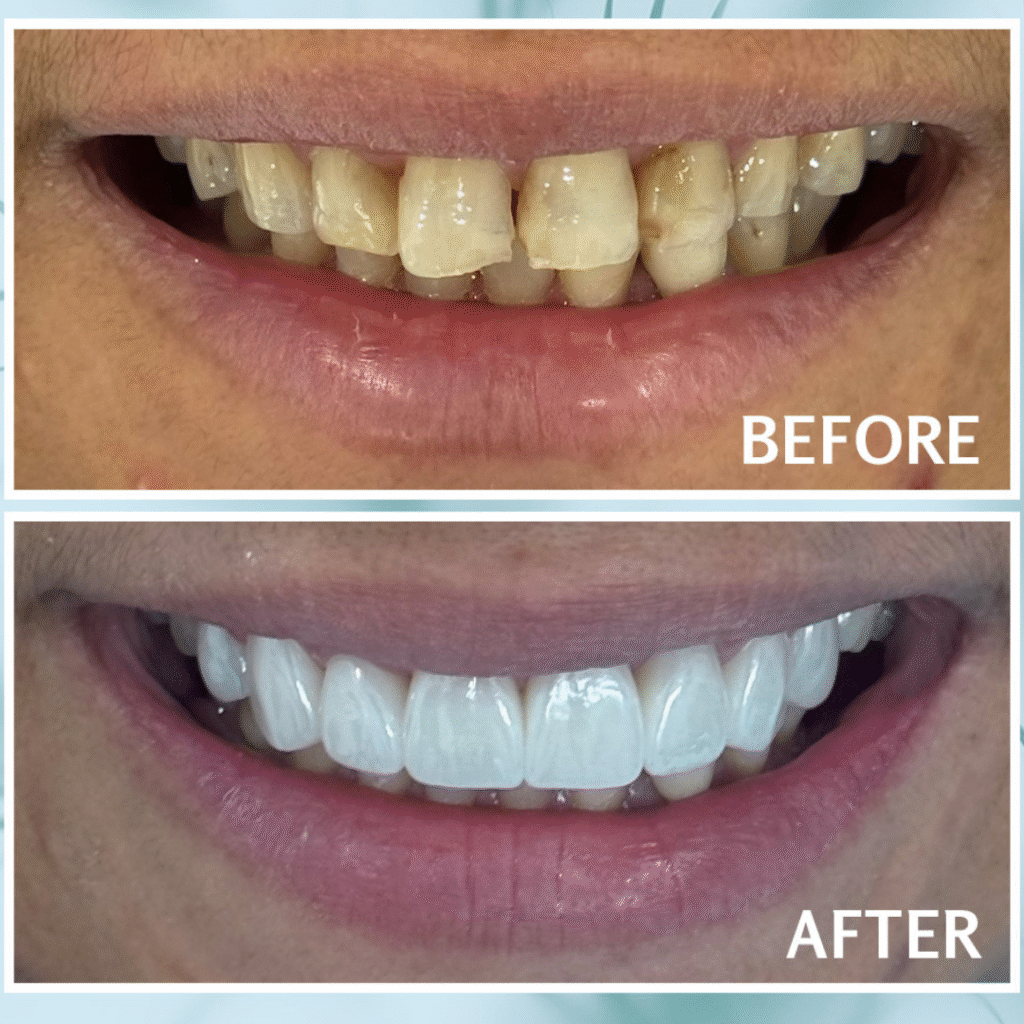
Modern ceramic crowns, when done well, are essentially invisible in the smile. The translucency, the shading, the shape – it all matches. Patients forget which tooth had the work done.
|
It’s like putting a band around the tooth. The crack is still there, but it’s held in place and can’t grow. That’s the goal – protect the structure before it fails. |
|
Answer: A dental crown holds a cracked tooth together by distributing bite force evenly around the entire tooth structure. When placed early, it stops crack progression and preserves the tooth indefinitely. |
Why Cracks Often Hide Under Old Fillings
Here’s something that surprises a lot of patients. Cracks don’t always show up where you’d expect them. Older teeth – especially ones with large silver fillings or composite restorations placed years ago – can develop cracks underneath the filling itself.
The filling was placed when the tooth was intact. Over time, the tooth structure around and beneath the filling can change. Cracks develop in areas the filling was never designed to support.
This is part of why a thorough clinical exam matters. It’s not just about what shows up on a standard X-ray. Sometimes we’re using transillumination, bite testing, and careful visual inspection to piece together what’s actually happening inside the tooth.
By the time a patient feels sensitivity or pain, the crack has often been developing for quite a while. That’s not a failure of awareness on the patient’s part – it’s just the nature of how these cracks progress.
|
Answer: Cracks frequently develop beneath existing fillings where they are not visible during routine exams. A comprehensive clinical evaluation – beyond standard X-rays – is often needed to detect them early. |
When Should You Actually Get It Checked?
The short answer: sooner than you think.
If you’ve noticed sensitivity to cold, a sharp sensation when you bite in a specific spot, or discomfort that comes and goes without an obvious cause – those are signals. Not every cracked tooth hurts. But when it does, that’s often the first indication that something needs attention.
Even without symptoms, if your dentist has mentioned a crack, or you’ve had a large filling for many years, it’s worth a proper evaluation. An asymptomatic crack is still a crack that’s progressing.
Signs Worth Addressing Sooner Rather Than Later
- Sharp pain when biting, especially on release
- Intermittent sensitivity to temperature without an obvious cause
- Discomfort localized to one tooth that’s hard to pinpoint
- Old, large silver fillings in back teeth – a known risk factor for cracking
- Any visible line or fracture mentioned at a prior appointment
At Riverview Dental Arts, patients from Riverview, Brandon, Valrico, and Apollo Beach come in regularly for exactly this kind of evaluation. Sometimes we find nothing concerning. Sometimes we catch something early that makes a real difference in outcome.
Either way, you leave with clarity.
|
Answer: Any sensitivity on biting, localized tooth discomfort, or a history of large fillings in back teeth warrants evaluation. Cracked teeth that are asymptomatic can still be progressing – early detection is the goal. |
Cracked Tooth vs. Chipped Tooth: Is There a Difference?
Yes – and it matters clinically.
A chip usually involves surface enamel. It may be cosmetically noticeable, but it doesn’t necessarily affect the structural integrity of the tooth. Depending on size and location, it can sometimes be polished smooth or restored with bonding.
A crack is different. It runs through the tooth – vertically, diagonally, or sometimes in multiple directions at once. It doesn’t stop at the surface. And unlike a chip, a crack has the potential to travel deeper over time.
This is why we evaluate the two differently. A chip is often a cosmetic conversation. A crack is a structural one, even if it looks small.
|
|
Chip |
Crack |
|
Affects structure? |
Usually no |
Yes |
|
Can progress deeper? |
Rarely |
Yes – toward root |
|
Typical treatment |
Bonding or polish |
Crown (early) or extraction/implant (late) |
|
Urgency level |
Moderate |
High – act early |
Frequently Asked Questions
Does a cracked tooth always hurt?
Not always – and that’s part of what makes cracks tricky. Many cracked teeth are completely asymptomatic in early stages. Discomfort, when it appears, is often intermittent and easy to attribute to something else. Don’t wait for pain to prompt an evaluation.
Can I just monitor a small crack at home?
Not effectively, no. You can’t see most cracks from the outside, and you can’t assess how deep one is running without a clinical exam. What looks stable can be progressing. A proper evaluation at Riverview Dental Arts takes very little time and gives you real information to work with.
What if the crack is under an old filling?
This is one of the most common scenarios we see at our Riverview and St. Petersburg locations. Old fillings don’t prevent cracks – in fact, large silver amalgam fillings can actually put more stress on surrounding tooth structure over time. If you have old, large fillings, they’re worth evaluating even without symptoms.
Is a dental implant really necessary if a cracked tooth is extracted?
An implant isn’t the only option after extraction, but it is typically the best one for long-term function, bone preservation, and aesthetics. Leaving a gap affects neighboring teeth and bone density over time. Dr. Espino will walk you through every option so you can make an informed decision.